From Human Computers to AI Collaborators
October 2, 2025 · Nick Carrino
From Human Computers to AI Collaborators
By: Nick Carrino
TL;DR: It's easy to see how computers enhanced, not replaced, workers in the past. Why is it so hard to see the same pattern arising in the present?
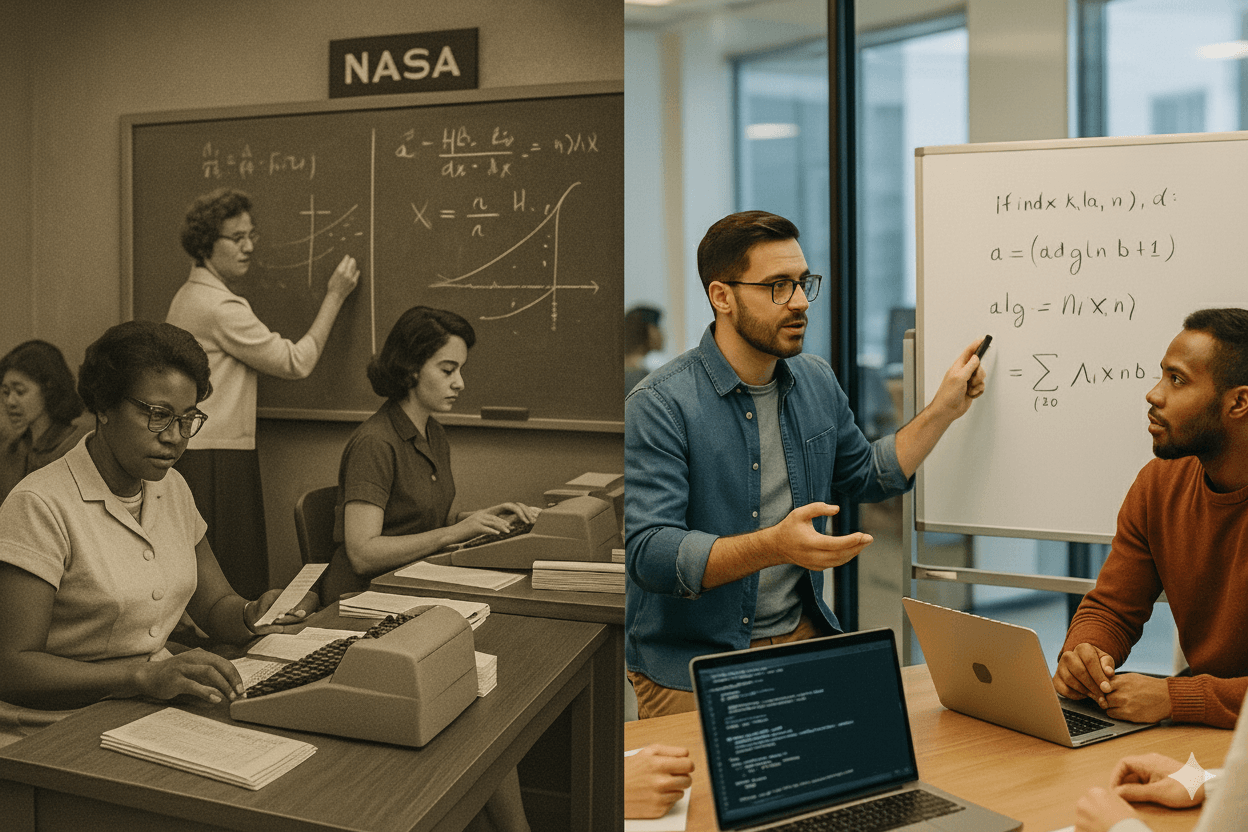
In 1969 when we sent Apollo 11 to the moon, we did not expect everyone in NASA to be able to do complex calculations. Those complex calculations that had to be done by people who had the job title of 'computer'. A 'computer' was someone who would, by hand, do the complex arithmetic and be accurate enough that we would be confident to use their work to send people off into space. These human computers were some of the smartest and most technically gifted people of their time. Now, anyone can do their job in the matter of seconds.
Notice, however, that this did not make mathematicians useless. In fact, it did the opposite. As the menial task of arithmetic was handed off to a machine, mathematicians were free to do more impactful work, especially in fields of applied mathematics. I'm sure there were some stubborn mathematicians left behind, but the vast majority of them took this new technology as a way to push the boundary of what can be possible. Leading to not only innovations in mathematics, but also in computer science, healthcare, economics, and more.
It's easy to see the success of a post-computer mathematician in hindsight, but it's hard to predict how the current white collar job market will adjust to artificial intelligence. It's easy to see how much one person can do and think that it can only lead to mass unemployment. However, it's hard to imagine a world where these massive efficiency gains leads to more fruitful and fulfilling work.
Mathematicians would never go back to the days of hand calculations as it would bore them and stop them from getting to what they really want to do.
People are beginning to see how much more fulfilling work can be when you don't have to worry about getting the email worded exactly correct, or have to spend hours finding that one document, or have to spend so much time writing the same boring document that you've done 1000 times before. White collar jobs will have to step up their game, but at least we have to opportunity to step away from the mundane and do work that is more expressive and fulfilling.
Nobody knows what white collar work will look like 50 years from now, but if history repeats itself, it will be one that frees people to do more meaningful, creative, and strategic work.